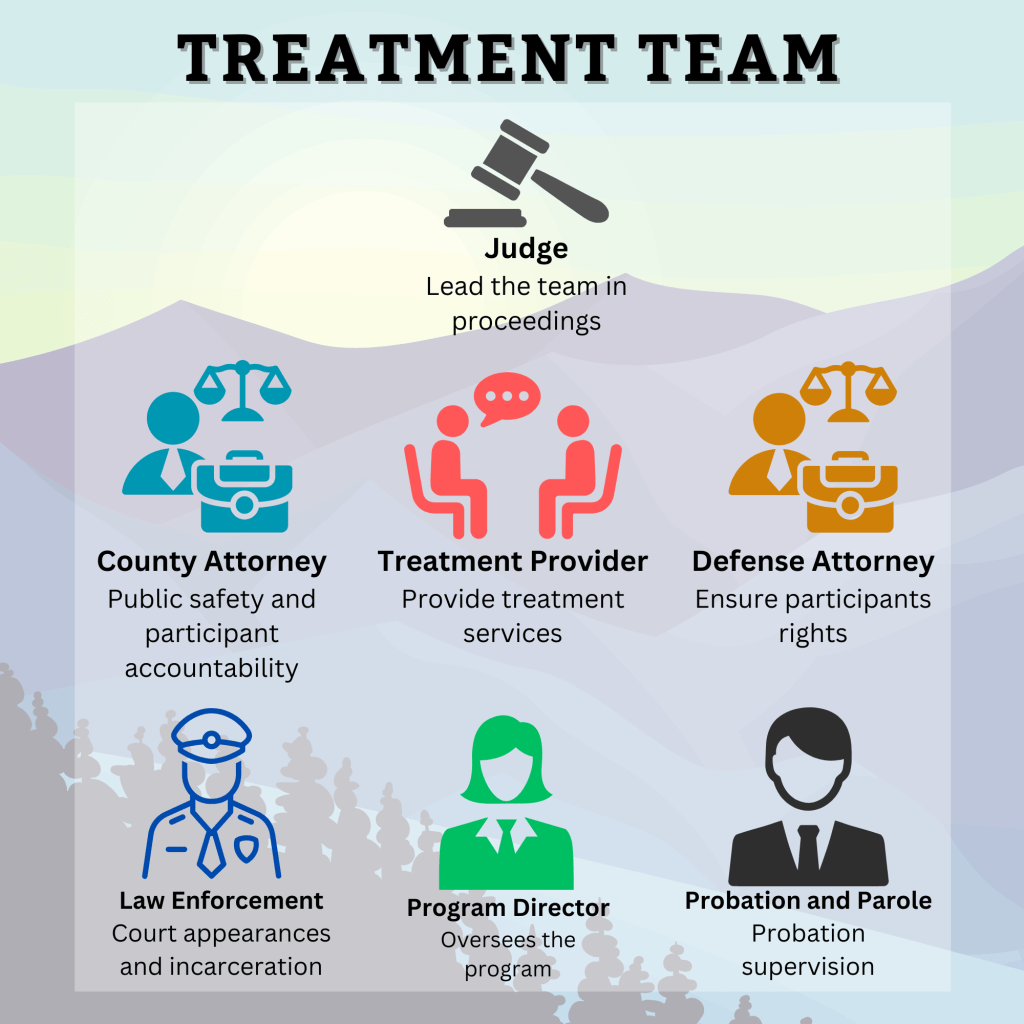
Judge
The treatment court judge stays abreast of current law and research on best practices in treatment courts and carefully considers the professional observations and recommendations of other team members when developing and implementing program policies and procedures. The judge develops a collaborative working alliance with participants to support their recovery while holding them accountable for abiding by program conditions and attending treatment and other indicated services.
Program Director
The program coordinator is the hub of the treatment court team. Often, this person is a court employee in a standalone role; however, in some courts, a trained probation officer, case manager, clinician, or other competent professional serves as the coordinator, in addition to their other duties. The coordinator keeps the program running smoothly and efficiently, ensures that it meets its obligations to funders, manages personnel commitments and adherence to best practices, obtains needed resources, keeps track of program performance information and participant outcomes, and assists the judge and other team members in educating the steering committee, advisory group, and other stakeholders about the services provided by, benefits of, and challenges faced by the treatment court.
Treatment Provider
Treatment providers play a pivotal role in facilitating recovery and reducing recidivism. They assess participants’ needs, develop individualized treatment plans, and deliver evidence-based interventions such as counseling, group therapy, and substance use education. Providers work closely with the drug court team, including judges, probation officers, and case managers, to monitor participants’ progress and ensure accountability. They report on treatment adherence, recommend adjustments to care plans, and support participants in addressing underlying issues like mental health challenges, trauma, or housing instability. By fostering a therapeutic alliance and emphasizing recovery, treatment providers help participants build skills for long-term sobriety and reintegration into the community.
County Attorney
A trained prosecutor is essential to the treatment court team. Outcomes are significantly better when a prosecutor serves on the team and participates routinely in precourt staff meetings and court hearings (Carey et al., 2008, 2012). The prosecutor ensures that information pertaining to public safety, victims’ interests, and accountability for participants receives careful consideration in all team discussions and decisions. As an officer of the court, the prosecutor also shares responsibility with the judge and defense counsel for safeguarding due process and the integrity of the justice system.
Defense Attorney
A specially trained defense attorney serves on the treatment court team and represents participants throughout their time in the program. The defense attorney owes their primary allegiance to the participants, not to the treatment court team or program (e.g., Citrin & Fuhrmann, 2016; Kvistad & Rettinghouse, 2023; National Association of Criminal Defense Lawyers [NACDL], 2009; Tobin, 2012). If a participant’s goals or preferences conf lict with those of the program or other team members, the defense attorney advocates for the participant’s stated interests.
Probation and Parole
Probation and parole officers ensure accountability and provide support to participants as they navigate their recovery journey. They monitor compliance with court-ordered conditions, conduct regular check-ins, and perform home or workplace visits to assess participants’ adherence to program rules. These officers act as liaisons between the drug court team and participants, providing updates on progress, reporting violations, and recommending sanctions or incentives based on behavior. They also support participants in accessing resources such as employment, education, and housing, while promoting a structured and law-abiding lifestyle. By balancing supervision and support, probation and parole officers contribute to the overarching goals of rehabilitation and reduced recidivism.
Law Enforcement
Adult drug courts are significantly more effective at reducing crime and are more cost-effective when a law enforcement officer, such as police officer or deputy sheriff, serves on the team and attends court hearings (Carey et al., 2008, 2012). Comparable studies have not been conducted in other types of treatment courts. Law enforcement often serves as the “eyes and ears” of treatment court on the street, observing and interacting with participants in the community, assisting community supervision officers or outreach caseworkers to conduct home and employment field visits (especially if there are safety concerns for staff), alerting the team about potentially eligible persons needing their services soon after arrest, informing recently arrested persons and their defense counsel about treatment court, and facilitating the swift enforcement of bench warrants for participants who have absconded from the program.

